はじめに:アスベスト関連の保険金請求は、企業およびその損害保険会社にどのような影響を及ぼしてきたか
米国でアスベストの使用が大幅に抑制されてから40年以上が経過した現在も、アスベストに起因する訴訟は、被告企業およびその保険会社に対して極めて大きなコスト負担をもたらし続けています。保険金・賠償金の支払いは依然として多額にのぼりますが、訴訟防御費用は、アスベスト訴訟対応全体において継続的かつ十分に対処されていない財務上の負担となっており、被告側にとって保険金・賠償金の支払いと同等、あるいはそれを上回るコストとなることも少なくありません。
現在、こうした訴訟防御費用の相当部分が、最終的に棄却される案件に関する手続き上の確認や申立て対応に充てられています。多くの企業では、提起されるアスベスト訴訟の半数以上が棄却に至っています。請求を早期に、より的確に識別できるようになれば、弁護士はより大きなエクスポージャーにつながる可能性のある案件に時間と専門性を集中させることができ、リスクの低い案件については、より効率的な対応が可能になります。
業界全体では、棄却案件に関連する法務費用は年間10億ドル以上に達すると推定されています。被告側にとって、この構造的な費用負担は事業運営の足かせとなっており、訴訟の初期段階における介入と解決に向けて、より効率的でデータに基づくアプローチが求められています。現在の傾向を踏まえると、初期段階のトリアージを少し改善するだけでも、被告企業およびその保険会社全体で年間数億ドル規模のコスト削減につながる可能性があります。
Introduction: How have asbestos-related claims affected corporations and their P&C insurers?
More than 40 years after asbestos use was largely curtailed in the United States, the litigation generated continues to impose extraordinary costs on corporate defendants and their insurers. Although indemnity payments remain substantial, defense costs have become a persistent and under-addressed financial burden on the system, often representing an equal or greater cost to defendants than indemnity payments.
Today, a substantial portion of that defense spending is devoted to procedural review and motion practice for cases that are ultimately dismissed; for many corporate entities, more than half of asbestos filings result in a dismissal. Improved early claim identification would help counsel focus their time and expertise on matters with greater potential exposure while allowing lower-risk cases to be handled more efficiently.
Across the industry, legal costs associated with dismissals are estimated at or above $1 billion annually. For defendants, this structural expense represents a drag on operations and calls for a more efficient, data-driven approach to early case intervention and resolution. Current trends suggest that even incremental improvements in early-stage triage could unlock hundreds of millions of dollars in annual savings among corporate defendants and their insurers.
Estimating the impact of asbestos legal defense costs for insurers
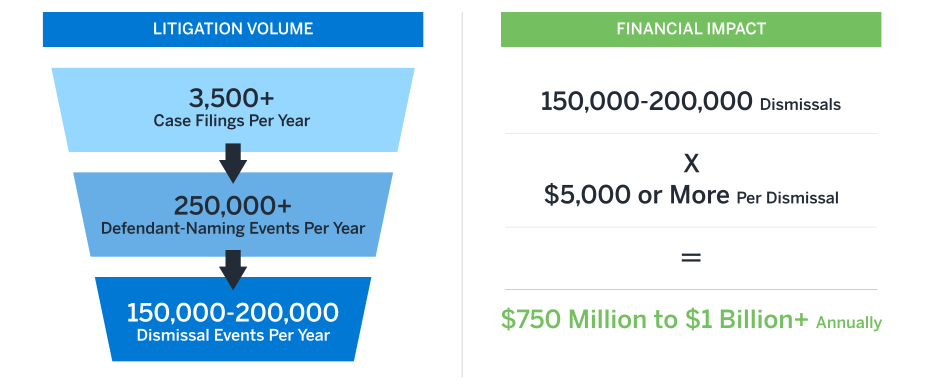
Each year, more than 3,500 asbestos cases are filed in U.S. courts.1 Because plaintiffs frequently name dozens, if not hundreds, of defendants in a single complaint, those filings translate into an estimated 250,000 or more unique defendant-naming events annually.
Dismissal rates in asbestos litigation remain persistently high. Based on Milliman’s observations working with top asbestos defendants, between 60% and 80% of named defendants’ cases may ultimately be dismissed, depending on the jurisdiction and portfolio mix. That implies 150,000 to 200,000 dismissal events per year across the industry.
Even when a case lacks credible exposure allegations, defendants must still respond. Intake review, corporate history research, motion drafting, and coordination with co-defendants consume valuable time and legal resources. Based on Milliman’s observations, early-stage evaluation and dismissal efforts can cost $5,000 or more per matter, depending on the defendant, jurisdiction, and complexity of corporate history review. Applied across the large volume of dismissal-prone filings each year, aggregate defense spending tied to these matters likely costs defendants and insurers $750 million or more annually. These expenditures are not driven by indemnity risk or exposure to large verdicts. Rather, they reflect the current state of the asbestos litigation environment where volume, over-naming, and procedural requirements generate recurring defense costs long before liability is established, diverting critical defense resources away from the cases that matter most.
Figure 1: Financial impact of dismissals in asbestos litigation
Why the burden of asbestos claims persists
Over-naming as standard practice
Modern asbestos complaints frequently name dozens of entities regardless of specific exposure evidence. Industry reports indicate that an average filing names approximately 75 defendants, with a meaningful share naming more than 150.2 One reason is that there is no precise burden of proof on the front end, so plaintiff firms are able to name as many defendants as they choose, even with little or no evidence of asbestos exposure. Some legislation, such as Iowa’s SF 2337 bill, signed in 2020, has attempted to curtail this issue by requiring a sworn information form specifying key pieces of evidence related to the claim.3 However, Iowa is far from a top state for asbestos litigation, and the average number of named defendants in other states has only continued to rise. This over-naming strategy shifts the investigative burden to the defense, requiring each named company to disprove involvement for each complaint. For the defendants, even clear noninvolvement does not eliminate cost. For each complaint, defense counsel must still go through a tedious, manual process to bring nuisance claims from filing to dismissal.
Manual asbestos claims reviews in a high-volume environment
Historically, evaluating individual claims for dismissal has relied on a detailed, manual review. Each dismissal typically requires many or all of the following steps between initial filing and ultimate closure:
- Review the complaint and analyze the defendant-specific allegation
- Review the worksite, occupation, and exposure history
- Investigate the product identification and corporate history
- Review the discovery responses, deposition testimony, and related case materials
- Coordinate with client representatives and sources of historical records
- Evaluate dismissal strategy and evidentiary sufficiency
- Prepare discovery, deficiency correspondence, and dismissal-related motion practice
- Conduct or participate in meet-and-confer efforts with plaintiff’s counsel regarding dismissal
- Draft declarations, briefs, and supporting filings
- Review the opposition review, prepare the hearing, and conduct the final dismissal proceedings
At current filing volumes, many portfolios have hundreds or thousands of active cases, meaning the early-stage evaluation steps represent a recurring and significant expense. The cumulative effect is substantial: legal departments and insurers devote significant financial and human capital to matters that ultimately resolve without payment.
Evolving asbestos litigation industry—and the impact on insurers
As the elevated filing volume persists, organizations are increasing focus on aligning legal effort with case-level risk at the earliest stages of evaluation. Other risk-intensive industries have long embraced predictive modeling to allocate resources efficiently. Underwriting, fraud detection, and claims reserving all rely on advanced analytics to ensure that human judgment is concentrated where it adds the greatest value. Advances in data science and artificial intelligence (AI) present a similar opportunity for asbestos litigation.
Using AI to analyze mass-tort litigation data
Milliman has been developing AI-based machine learning models to analyze mass-tort litigation data for supporting immediate case evaluation, leading to efficient case management decisions. Drawing on decades of historical asbestos data, these models use information derived from complaints to assess the risk of settlement for each claim and assign a likelihood of dismissal. This enables defense teams to:
- Instantly identify high-probability dismissals at intake
- Reduce repetitive manual review
- Direct attorney time toward matters with greater potential exposure
- Enhance budgeting and reserve forecasting
- Reduce defense cost leakage
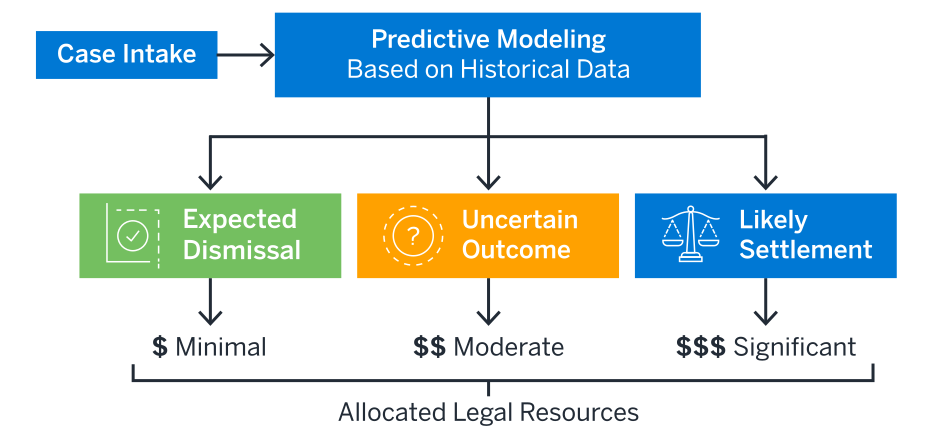
This approach allows newly filed claims to be systematically segmented into three categories upon filing: expected dismissals, cases with mixed or uncertain outcomes, and cases likely to result in indemnity payments. This segmentation enables legal resources to be allocated more effectively, with streamlined handling for likely dismissals, targeted review of borderline matters, and greater attention to higher-risk claims. It also provides a foundation for future enhancements in the identification and management of the highest-risk claims.
Figure 2: Claim segmentation process and allocation of legal resources
For insurers, the implications extend beyond immediate legal savings being realized by their corporate insureds. Early insight into dismissal probability can inform reserving assumptions, capital allocation, and portfolio-level risk assessment, creating a tighter link between litigation analytics and financial strategy. With an estimated 150,000–200,000 annual filings that eventually lead to dismissals, even modest improvements in automation and claim triage would generate substantial efficiency gains and cost savings for corporate defendants and insurers.
AI-powered analysis of asbestos insurance claims: Broader implication for corporate defendants
Given the long manifestation period for asbestos-related diseases, asbestos litigation is unlikely to disappear in the near term. Filing volume remains high, and currently the system favors expansive naming strategies. However, the cost structure of defending these cases is not set in stone. Corporate asbestos defendants have historically focused on indemnity reduction, settlement strategy, and global resolution structures.
Defense cost management, particularly for cases that ultimately dismiss, has received less strategic attention. This overlooked area presents a meaningful opportunity to allocate defense resources to the highest-risk claims while reducing structural litigation expenses associated with dismissals. In an environment where capital efficiency and expense discipline are critical, a data-driven approach to managing dismissal-heavy portfolios is not just a technological enhancement—it is a financial necessity.
1 See page 3 of KCIC (2025). Asbestos litigation: 2024 year in review: KCIC industry report. Retrieved July 15, 2026, from https://www.kcic.com/media/2462/kcic_report_asbestos-annual-report_2024-1.pdf.
2 See page 11 of KCIC (2025). Asbestos litigation: 2024 year in review: KCIC industry report. Retrieved July 15, 2026, from https://www.kcic.com/media/2462/kcic_report_asbestos-annual-report_2024-1.pdf.
3 See Iowa Senate File 2337, 88th General Assembly, Regular Session (2020). Retrieved July 15, 2026, from https://www.legis.iowa.gov/docs/publications/LGE/88/SF2337.pdf.